
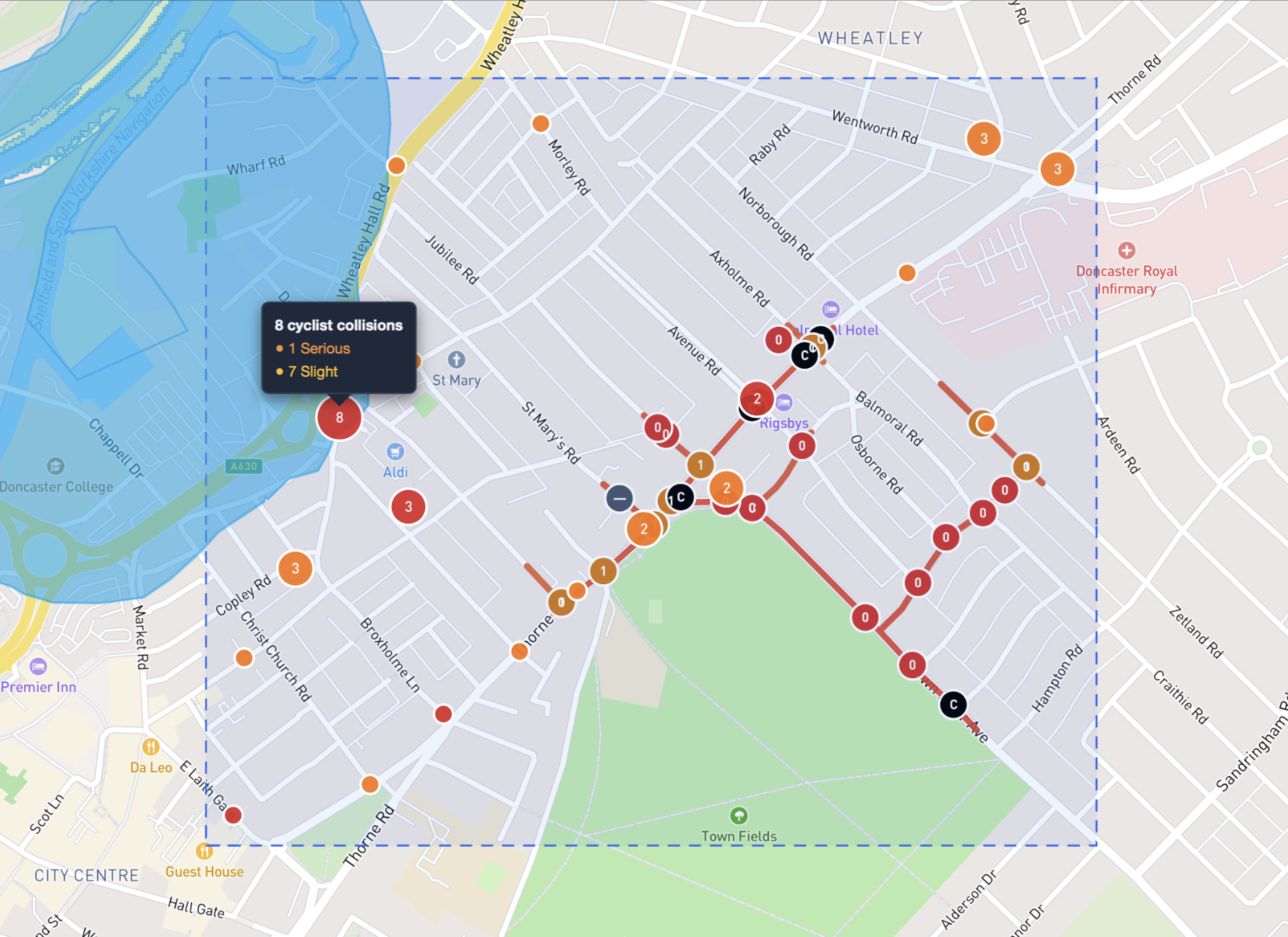


Two ways to work with StreetVision.
Run your own assessments on the platform, or have us deliver a full network assessment for your city. Both produce the same evidence-led, auditable output.
Run your own route checks
Log in, draw a route and StreetVision pre-scores Active Travel England (ATE) Route Check metrics from mapped data and street-level imagery. Your engineers review the evidence, override where needed and export an audit-ready assessment.
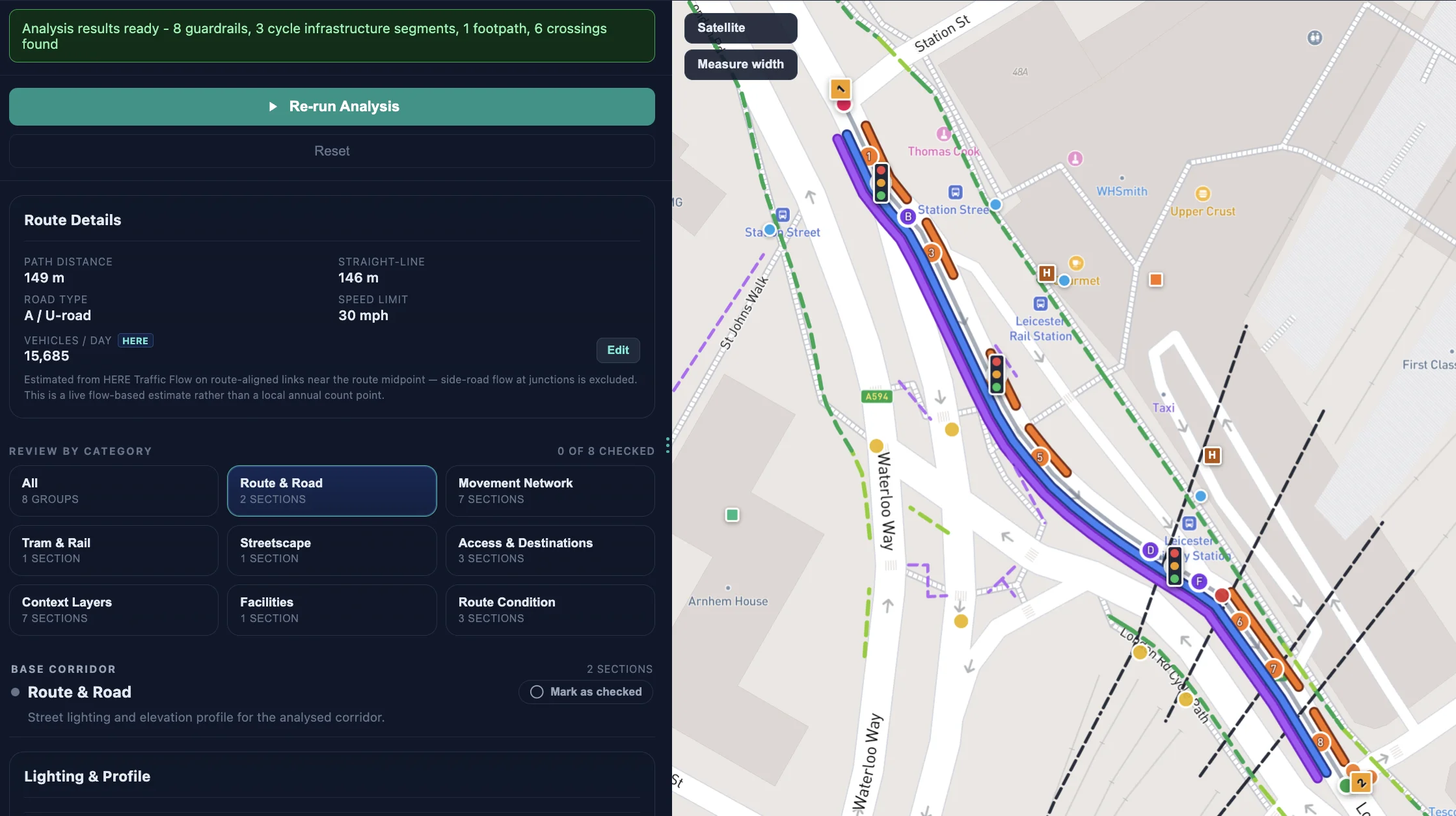
- Draw routes and split segments in minutes
- Metrics pre-scored with evidence attached
- Review, override, comment and export
How consultancies, a national active travel body and local authorities use StreetVision.
Book a walkthroughWe map your whole network
We run the full pipeline over your city — imagery, computer-vision sweeps and scoring rubrics adapted to local standards — and hand back a network-wide assessment map with option analysis and investment insight.
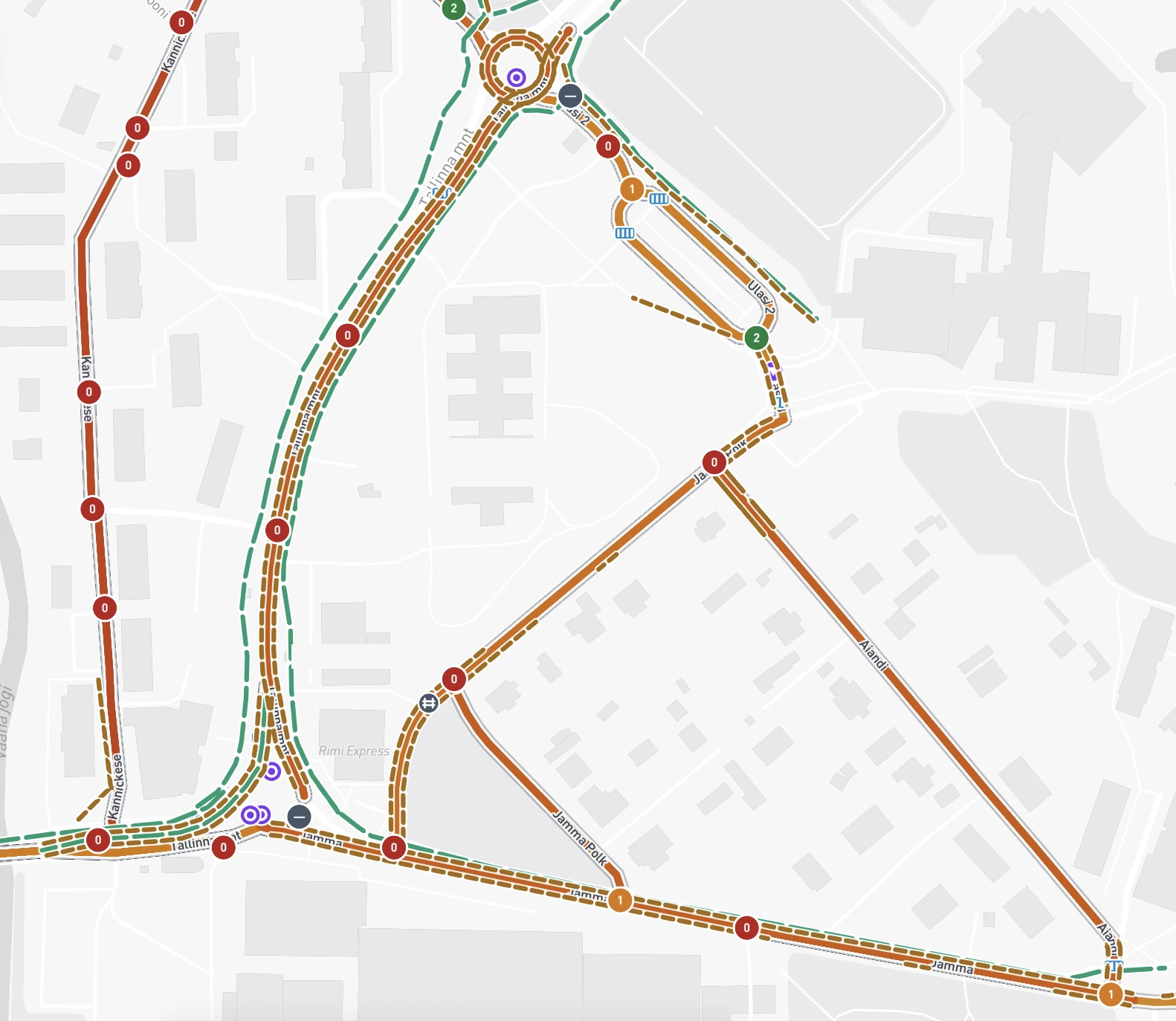
- City-scale assessment maps of safety, comfort and cohesion
- Rubrics and data sources adapted to local standards
- Weak links, route options and investment priorities identified
How we deliver city network pilots across the UK, Europe and beyond.
Talk to us about your networkLess assessment effort. More evidence. Already in use.
StreetVision runs live assessments for public bodies and consultancies today. Engineers keep every score, and the evidence trail scales from a single route check to a whole city network.
Self-serve route checks live today. Network assessments delivered in the UK, Estonia and Lithuania.
Assessment effort drops. The evidence trail stays.
Figures from current workflows on live route checks and delivered network assessments.
of engineering assessment time saved
Measured on current route check workflows against manual desktop review.
of network assessed in a week
Example delivery rate for a city network assessment, at a fraction of the cost of a manual audit.
metrics in one assessment map
Safety, comfort, access and cohesion scored across a network, with the evidence behind every score.

In production today
Engineering consultancies, a national active travel body and local authorities in the UK run their own route checks on the platform.
Network pilots delivered
Full network assessments delivered for European cities and districts, with scoring rubrics and data sources adapted to local standards.
Active travel domain expertise
Built with direct understanding of route checks and engineering assessment workflows.
Public-sector workflow focus
Designed around auditability, review states, evidence and controlled project visibility.
“We have not come across any other technology that combines such granularity, a holistic overview and expert urban insight.
“StreetVision’s assessment map covers 53 individual metrics, showing not only where our network falls short, but also where it performs well and why.
“Done traditionally, the manual surveys and geodetic data collection would have taken us weeks, if not months. We are excited to work with technology that has finally matured and is now being deployed in physical infrastructure planning.
“We are proud to be among the first in Estonia and in Europe to use AI to assess our streets at such an unprecedented level of detail.”

Preparing or updating a SUMP?
431 European urban nodes must adopt a Sustainable Urban Mobility Plan by the end of 2027. StreetVision delivers the walking and cycling evidence behind it: a mapped baseline, costed options and repeat monitoring.
Infrastructure assessment is becoming a bottleneck.
Active travel schemes increasingly require structured evidence, consistent scoring and transparent review. But many teams still rely on manual analysis, spreadsheets, fragmented GIS layers and repeated engineering judgement. This makes assessment slow, difficult to standardise and hard to scale across multiple routes, city areas or option comparisons.
Too much assessment work is still assembled by hand.
The result is slower review, harder comparison and less confidence when decisions need to be explained to funders, members, stakeholders and delivery teams.
Manual workflows
Route checks and evidence gathering are still heavily spreadsheet-based.
Fragmented evidence
Imagery, GIS layers, comments and scoring often sit in separate places.
No network picture
Cities struggle to see safety, comfort and cohesion issues across whole active travel networks.
Hard investment choices
Without consistent evidence, prioritising routes, costs and interventions is difficult to defend.
Assess, map and compare active travel infrastructure.
StreetVision is the infrastructure intelligence layer for active travel networks. It brings route checks, city assessment mapping, evidence review and network option analysis into one workflow, so decisions stay connected to the data, imagery, scores and assumptions behind them.
Assess detailed corridors
Map city-wide issues
Prioritise investment
Route and corridor assessment
Draw routes, split segments, collect evidence and review ATE-aligned or locally configured metrics.
Connected review evidence
Keep imagery, mapped data, notes, scoring logic, comments, overrides and confidence states together.
City assessment mapping
Assess routes, corridors or whole city areas for safety, comfort, access and cohesion issues.
Cost-aware optioneering
Compare route options by safety, comfort, demand, estimated cost, utility and confidence before export.
One workflow from route definition to export.
Designed to reduce repeated desktop assessment effort while preserving professional judgement.
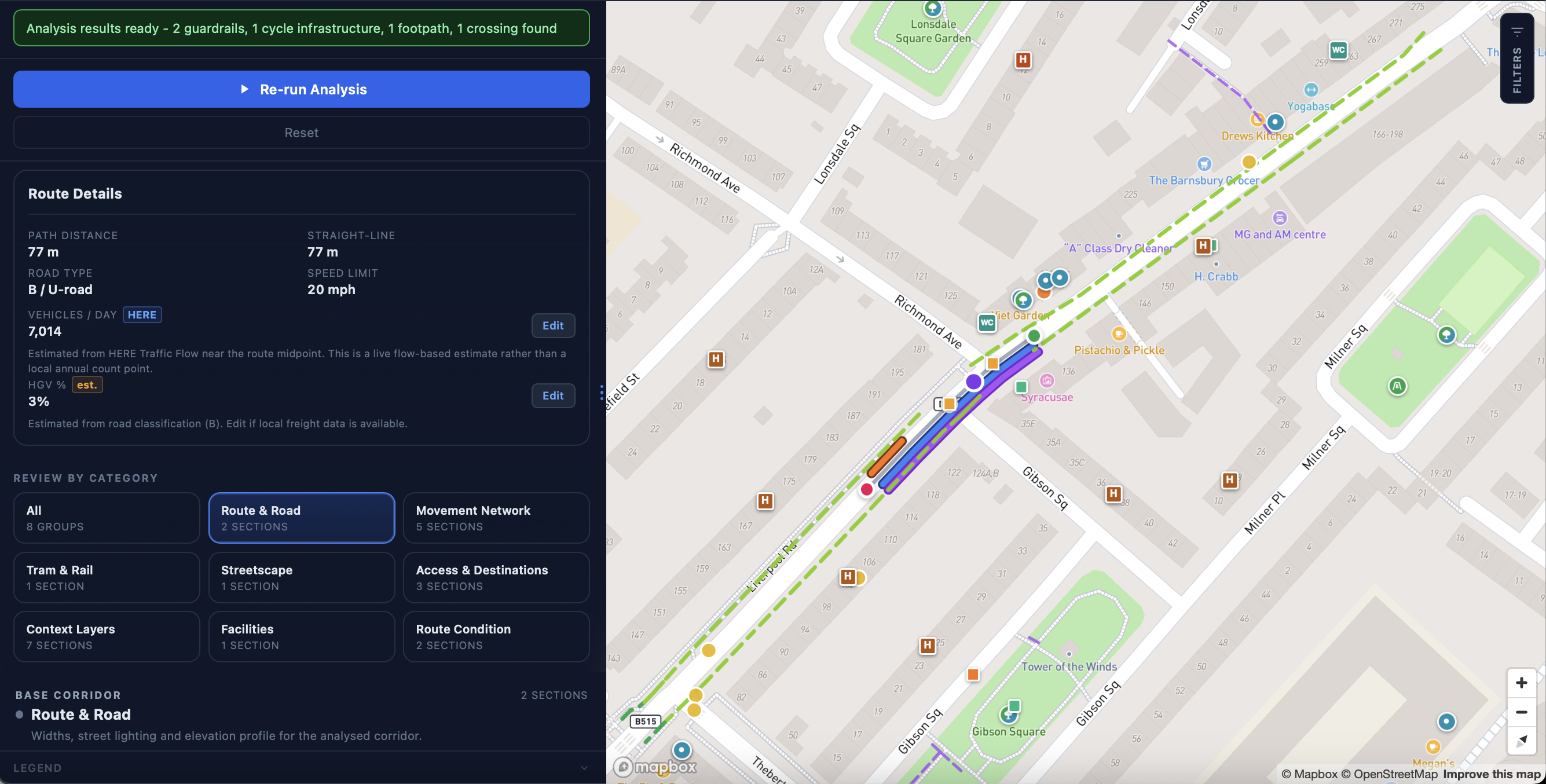
Set the route check, corridor, scheme or network area.
Draw routes, split segments and manage options.
Pull together mapped context, street-level imagery and reviewer notes.
Work through ATE-aligned or locally configured assessment criteria.
Compare route options, weak links, estimated costs, utility and confidence.
Produce auditable summaries, reports and spreadsheet-ready outputs.
Running ATE Route Checks?
Draw the route and StreetVision pre-scores Active Travel England Route Check metrics from mapped data and street-level imagery. Your engineers review the evidence, override where needed and export an audit-ready assessment.
Map whole networks, then compare what to build next.
StreetVision helps cities move beyond one-off route reviews. Assessment maps can show where walking, wheeling and cycling infrastructure is unsafe, uncomfortable, disconnected or inconsistent across corridors, neighbourhoods and whole network areas.
Network analysis then supports decision-making: compare route options, weak links, likely interventions, estimated costs, safety, utility, demand and confidence before prioritising investment.
Route evidence becomes a reusable city-wide infrastructure intelligence layer.
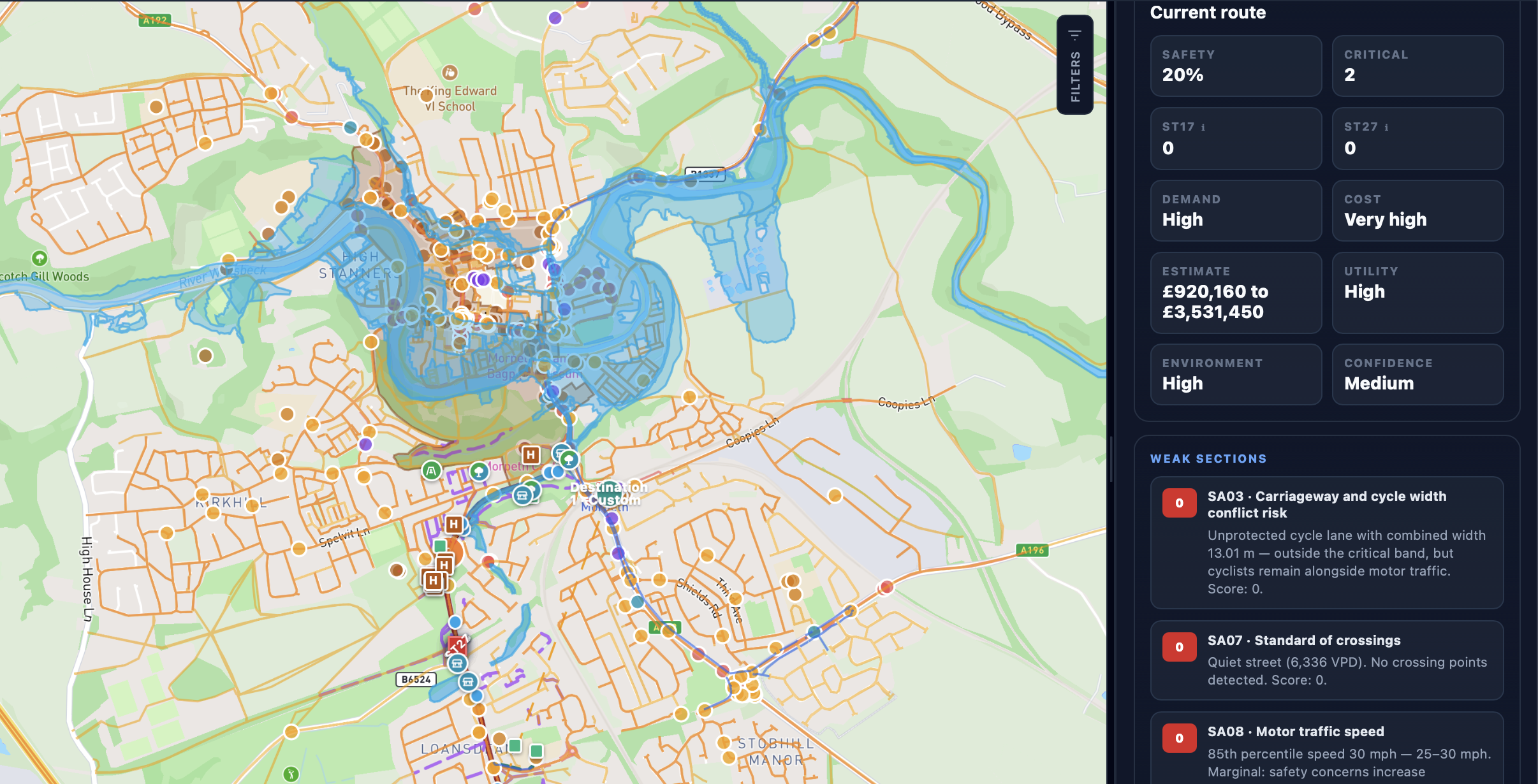
City assessment map
Build a mapped view of active travel infrastructure quality across routes, corridors or whole network areas.
Safety and comfort issues
Identify where walking, wheeling and cycling conditions are unsafe, uncomfortable or inconsistent.
Network cohesion
Understand where routes connect well, where links break down and where barriers reduce active travel uptake.
Option analysis
Compare potential route options, interventions and corridors before committing engineering effort.
Cost and utility estimates
Bring estimated costs, demand, safety, utility and confidence into the same decision view.
Investment priority areas
Target funding where infrastructure improvements can create cleaner, healthier and more active places.
Safety risk mapping
Show where users face higher-risk crossings, junctions, gaps or uncomfortable conditions.
Comfort and access scoring
Track whether walking, wheeling and cycling infrastructure is attractive enough for everyday trips.
Cohesive network planning
Find missing links and corridor issues that stop routes working as a connected network.
Defensible investment
Prioritise interventions with a visible evidence trail, not isolated opinion or static maps.
Designed to reduce assessment effort and improve confidence.
Pre-scored metrics, shared scoring logic and connected evidence make route, network and investment decisions easier to evidence, compare and defend.
Faster review
Pre-scored metrics and structured workflows cut repetitive desktop review to a fraction of the manual effort.
More consistent scoring
Use structured workflows and shared scoring logic across teams.
Cost-aware decisions
Compare route options with estimated cost, demand, utility, safety and confidence in view.
Scalable network insight
Move from individual route checks to city-wide network assessment and investment planning.
Built for the organisations shaping active travel networks.
StreetVision is designed around the practical detail of ATE Route Checks, then extends the same evidence-led workflow to corridors, cities and operating areas. That helps investment reach the places where better walking, wheeling and cycling facilities can have the greatest impact.
Local authorities
Assess schemes, map network issues and prepare evidence-backed reviews that help improve walking, wheeling and cycling facilities.
Engineering consultancies
Standardise route checks, reduce repetitive desktop work and deliver clearer outputs for clients.
Transport agencies
Review infrastructure quality across corridors, schemes and network areas, then compare intervention options.
European cities
Benchmark cycling and walking networks so investment can support cleaner, healthier and more active cities.
Micromobility operators
Understand infrastructure conditions across operating areas and support policy, tender and safety conversations.
Insurers and risk teams
Use infrastructure context to support area-level risk narratives and network comparisons.
Pilot StreetVision on a live corridor or network area.
A typical pilot is designed to validate the workflow against a real route check, corridor study, network planning area or option comparison.
By the end of the pilot, the organisation should understand whether StreetVision can reduce manual assessment effort, improve consistency, map infrastructure issues and support evidence-backed investment decisions.
Kick-off and data scoping
Area selection
Local dataset configuration
Route assessment workflow
Evidence and metric review
Network option analysis
Estimated cost and utility review
Exportable outputs
Feedback and pilot review session
Best fit for
Practical controls for public-sector and consultancy workflows.
StreetVision is built around the realities of public-sector review, collaborative project teams and data handling requirements.
Role-based access
Controlled permissions for project teams, reviewers and collaborators.
Audit trails
Review states, comments, overrides and export history designed for traceability.
Project visibility
Workspace controls for live corridors, network areas and pilot scopes.
Evidence provenance
Keep scores, comments, imagery, assumptions and reviewer actions connected.
Data handling
Supports DPIA, procurement and data-governance conversations, with documentation shared during pilot scoping.
Assurance
Security, documentation and assurance controls developed openly alongside pilot and deployment requirements.
Book a pilot walkthrough with a live corridor in mind.
Share the route check, city network area, option analysis or assessment workflow you want to validate. We will respond with a practical pilot scope and product walkthrough.